Robert Owens: House Is A Feeling.
Updated: Jun 3
Robert Owens has a story to tell, and he needs no questions to tell it. Our ninety minute video call from his home in Berlin begins with a series of unprompted memories that in a few sentences takes in his flat sharing with Frankie Knuckles in the eighties to giving costume advice to Sylvester at a gig in Chicago. My ideas of what we’re going to talk about, and what this interview will be, are quietly laid aside. Often interviewing requires prompting and prising to get to the gold but sometimes, when the Muse of disclosure throws a fistful of glitter your way, you know to keep it shut and let them flow. In that voice that has moved so many people on dance floors the world over, I felt like I was receiving an a cappella on the history of club culture.
“You know, a lot of people are not aware that I came out of the disco era, before house even evolved. You think back to Studio 54. I played there. Larry Levan was DJing and me and Salt-N-Pepa were the acts for the evening. I performed at Paradise Garage with Loleatta Holloway. She took me under her wing like a mother figure. I opened for Grace Jones at the Palladium in New York and we did the gay Olympics together in Amsterdam.” His point of coming up in the disco era references some of the most seminal names in its history. It may have been disco, but it’s also indisputably house.
As his spine-tingling track with Harry Romero testifies, Owen’s dance and musical roots go back, way back, to a childhood in Chicago where his talents were recognised early. “I remember as a kid, I had an aunt that used to put me on the table and tell me to dance for her friends. She’d say, ‘Look at that kid, he’s gonna be something. I'm telling y'all.’” The voice that would be one of a handful to define house music was cultivated in the church of his devout mother. “I sang in church and people enjoyed it, but I discovered only for as long as you were doing what they wanted you to do. As soon I started making my own music and the whole gay angle - that didn’t go down with the family. Suddenly I’m gonna burn in hell and all this narrative. I was like, ‘Okay, move on…’”
The world that he moved on to, and the characters he was to find in the city’s clubs of the late seventies and early eighties, had a cultural impact that has reverberated around the world to the present day. Not everyone may understand house music, but find me a person with a pulse who hasn't heard it. Like its contemporary creative twin New York, the interplay in Chicago's subcultures between music and nightlife, experimentation and fashion, alienation and belonging, ostracism and chosen families merged to create new and distinct creative forms.
“You know,” he continues, “a lot of these kids were having problems at home or didn't have a home. They were living house to house but we found family within those new structures. That's where the whole ballroom culture comes from in New York, but it was just a different type of circuit in Chicago. It was about the music and love and escapism away from normal reality, but I feel the sentiment was similar to the ballroom scene and finding family.”
Owens describes a scene that offered a Wizard of Oz Technicolor contrast to the greyscale demands of everyday life. “You came into this environment where some of these people looked like caricatures off TV and the height of fashion. The gay clubs where you needed membership were the places that set the style and you’d have people cramming outside to get in on someone’s membership. It was special and had a mystique. It felt like you were being brought into a wonderland of happiness and a joyful community.” He pauses and smiles. “There were also the drugs... the punchbowl was very popular.” Let’s just say the main ingredient wasn’t Malibu.
While most associate him with being a vocalist, he was a DJ long before he would record those foundational records with Larry Heard and Frankie Knuckles. “I started DJing at house parties before getting a residency in a pub six nights a week. I’d play Prelude and Salsoul and right back to stuff on Chess Records, that’s how people first knew me. Later, we all started hanging out by the North Pier where Frankie

and others started doing parties. Sometimes we’d dance around a boombox and then move on to someone’s house. So we’d go to K Alexi’s and then Gene Hunt’s, they’d come to my house then we might go to Frankie or Ron Hardy's house.
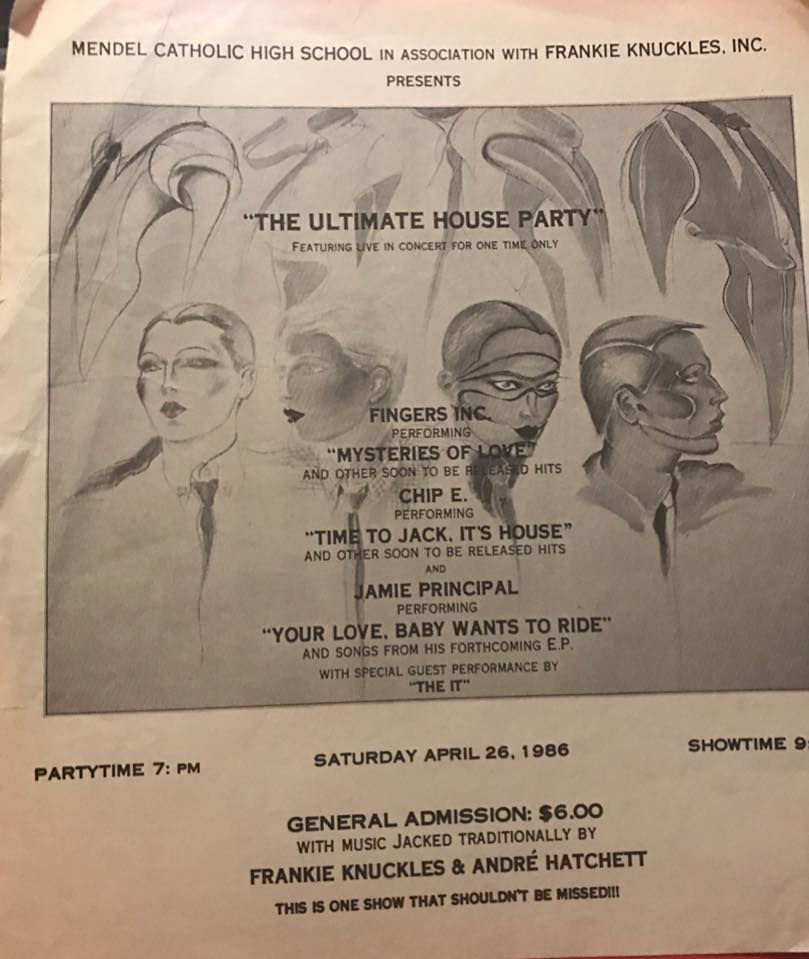
Owens started making his own early music on a Pioneer pitch control tape deck. “I had drums and maybe six or seven tape decks that I’d use for splicing, mixing and over-dubbing and end up with something of a master. A friend of mine, Tony Harris, introduced me to Larry Heard and he gave me some of his tracks. Larry back then for me was a really talented musician, but he wasn’t so tapped into the club circuit. I was the club kid and brought him into those spaces. He shared some of his stuff with me and I was like, ok, this guy’s got something here. Around that time Ron Hardy got sick one night and Robert Williams, the founder of the Warehouse, asked me to come in and cover and I introduced for the first time there some of Larry’s early tracks like Mysteries of Love, Washing Machine, and Can You Feel It?. I think I played Mysteries of Love three times and every time the people went into something like a trance. That confirmed it for me that Larry had something.”
Not long after this Heard invited Owens over to his house to play him some new music that he had been working on. “He put these tracks on and instantly I knew I had the words to match. I think that first night we wrote A Path," he says. “I think that surprised him that I was so natural and quick.”
Impressed with their compatibility, Heard asked him that night if he wanted to form a group. “And so we formed Fingers Inc and recorded straight away. With some people recording is not easy, but with us it was always natural and flowed. It was a pleasure. And we were neighbours too, back then most of us lived in the North Side area but with us he was round the corner, at one point we lived across the hall from each other, and so I’d go over with some lyrics and ask what he had and he’d hand me the mic and bam, I’d just go into it. That’s how we made Bring Down The Walls. In fact, we made it so fast that the doorbell that can be heard on it was someone ringing Larry’s front door while we were recording. He just told me to keep going and so it stayed. When that doorbell came on at Paradise Garage people started screaming, they loved it.”

With fellow vocalist Ron Wilson making it a trio, Fingers Inc. released Another Side in February 1988. Four decades on it stands as a foundational record of deep house, a Chicagoan peer of Ten City’s Foundation and Lil Louis’ From the Mind of Lil Louis. While Heard has said there was enough material for a second album, Another Side remains Fingers Inc’s sole long player. A contributing factor to a second album not appearing was Owens move to New York in the late eighties, a move in part prompted by the creation of a track that has proven itself as timeless as it was influential.
“Frankie Knuckles had been back and forth to Japan where he met Satoshi Tomiie. He had a track called Tears and wanted to meet me to possibly sing on it. So Frankie said he’d put the feel out in Chicago and see if I wanted to write the lyrics. One night Frankie was in Chicago playing above the Smart Bar at Metro he played the track. I went home that night after hearing it - I was in between jobs and staying at my mum and dad’s at the time - and wrote the lyrics. I called Frankie that night and recited them over the phone and two days later I was flown to New York to record it in the studio.”
Soon after he relocated to New York, arriving in the city during its creative peak when its culture was conquering the globe. Owens threw himself into everything it had to offer. “New York compared to Chicago was a whole other world,” he says. “I ran clubs there like Visions. That was a successful night, sometimes we had over two-thousand people in. I had Barbara Tucker there, Spike Lee came down and Janet Jackson. It was common back then to see these stars out in New York back then, a bit like Hollywood. I'd see Keith Haring just hanging out, it was like that."
For a while he lived with Frankie Knuckles on the Lower East Side, and started to write for Judy Weinstein’s Def Mix Productions which had both played, and benefited from, its role in Tears. The production house would produce his first solo album, Rhythms In Me, which had Jocelyn Brown and Connie Harvey on backing vocals, as well as first major solo hit I’ll Be Your Friend, but the demands of the company sat uncomfortably with his temperament.
“Sometimes it was like being in a military drill,” he says. “You’d be straight in the club, straight to the dressing room, not talking to anybody. It was like a regiment that put me on edge. I wasn’t used to that, you know, I’m a people oriented person.” Navigating the New York music industry and its politics and domineering personalities was not without its challenges, and he admits that he made some decisions that were not always in his best interest. Having by then had a years-long relationship with the burgeoning house scene in Britain, the difficulties he felt in New York had him move to London in the early nineties and where he would spend the next two decades.
“I’d been going back and forth to England for a few years and as Fingers Inc we toured up and down the country: Newcastle, Manchester, all these places we visited on a tour bus doing back to back nights. Some places were hip hop joints and I’m thinking, ‘They’re gonna kill us’, but we’d get out there and they’d love it. The first tour was with Marshall Jefferson, Kevin Irving, and Adonis. Frankie joined for a date or two,” he says, visibly lighting up. “Going to England then was like a fairy tale for me, I was overwhelmed but we instantly made friends with people there. And then I started getting work all over Europe. I did the opening of Queen in Paris and started to get work I’d never get in America.”

He describes feeling more at ease and free of what he felt was a competitive edge in the US. “Some people were jealous of our success over there but I’ve never felt the need to compete. I’ve always been a team player and I think many back home took that as naivety. It’s true I accepted behaviour from people that I shouldn’t have but I chose to learn and grow from that.”
There is a soft, playful lilt to Owen’s voice that contains a lifetime of experience, both the joy and sadness. If a house is a feeling, then the feeling is deep. It’s the quality that makes his music so instantly recognisable.
“I’m so grateful to still be here and doing what I do,” he says. “I believe that some
people come into your life for a season, and some come in for a reason to teach you a lesson. You have to accept whatever it is and then let it go. Be grateful, ensure that you understood what you were receiving and the purpose of these individuals to come into your life. And then some people come to stay. It comes full circle I try to have that emphasis of wanting to give back to humanity because something was given to me.”
His own record label Musical Directions is over thirty years old and provides him with a platform to promote both his own creative output and those he wants to support. “You know some people did things in business to me that I was so surprised by. ‘They really did that?’ I thought. But I learned not to cry over spilt milk. These days it's all these amazing new young people just driving me and pushing me, and so I feel a responsibility to be there for them to do the right thing. People can come to me and ask me anything and I’m open to it. It's like you have to do the reverse of what people did to you. I ask myself, ‘What are you gonna leave behind?’, ‘What did you give back?’”
As a gay man who lived through the AIDS epidemic, I ask how the loss of so many of his friends affected him. “It was like a big nightmare,” he says, “but I feel like they're shining down on us. I believe in spirits, not all the ideologies of religion, but I believe when people pass their souls go somewhere. I think I'm constantly being guided by people that have moved on and that their spirits are with me.”
One spirit who has ascended into Heaven - and let no motherfucker argue with that - is Sylvester. “We were at a gig together in Chicago and he asked me, ‘Honey, which one of these gowns should I wear?’ and I just said, ‘That one there works for you.’ He was nervous thinking the crowd looked straight and I reassured him that we played his music all the time. They loved him but he had a vulnerability to him which surprised me. I remember that he turned up alone. Some of those legends were hardcore, they couldn't let people in because of fame and what the industry had done to them, but he spoke to me openly and as an equal.” Owens recalls meeting other luminaries like Miles Davis and what he learned from these meetings with musical legends.
“That's the thing that keeps me inspired and keeps me wanting to grow. What kind of message did I take away from those encounters? It’s to give and never make someone feel small, never make them feel like they don't matter. Be open to learn from them. Be mindful of what you are giving, be balanced. Because there’s too often a focus on status and belittling others. I don’t have time for that. I’ve met giants, and they didn't treat me like that, so why should I take it from anyone else?"
Owens has lived in Berlin for the past ten years. His life has been a decades-long pilgrimage from Chicago to New York, London and now the German capital. All four cities have changed, but all have at various times been epicentres of electronic music and nocturnal culture, their influence reaching far beyond their national boundaries. As a gay, Black man who was integral to the emergence of house music, his continuing presence endures as a living reminder of the genre's roots. "House is a feeling, man," he says. "Like-minded people gravitate towards each other."
Robert Owens is playing Handsome with Spatial Awareness on Saturday 9th May at Eagle London. Tickets here.
Words by Martyn Fitzgerald.


That was an incredibly insightful interview. The story shared was not only compelling but truly inspirin.
Woah…beautifully written.
What an interview!
What a story!
Literally captures history in the making.
Long Live Robert Owens & House Music!
✨🎶🪩