Alinka & Shaun J. Wright: Chicago housekeeping.
Shaun J. Wright and Alinka are the DJs, producers, and promoters behind the respected house label Twirl Recordings and the hugely successful Chicago parties of the same name. Here they speak to Martyn Fitzgerald about life growing up house in the Windy City.
Shaun J Wright and Alinka, start and finish each other’s sentences, testament to a deep friendship and years of late-night talks. As well as being label owners and promoters, they are sought-after DJs and producers and, in Wright’s case, a distinctive vocalist. We meet online, with Alinka in her adopted home of Berlin and Wright in their hometown Chicago, to discuss their beginnings in the city and how its house and club culture shaped both their lives.
Wright grew up in Maywood, a predominantly Black neighbourhood in the west of the city. “It was a privileged childhood because there is never a point in my life when I don’t recall house music,” they say. “I was born in ‘82 and culturally it was always present, always on the radio and on the speakers.” Alinka arrived in the US aged 8, having emigrated with her family in 1988 from Soviet Ukraine via Vienna, where she learned German from watching cartoons. After a few months in the Austrian capital the family moved to Edgewater, a lakeside community on Chicago’s North Side. “They sent us Jewish refugee kids to school to learn English and Hebrew,” she says. “None of us were religious as we’d grown up under communism, so it was a culture shock learning to pray and these new languages and what was on offer. We didn’t have half the things that were available in the US. I remember the first time I had a banana - and of course music and pop culture. It was an American rebirth.”
Growing up in the 80s and 90s in the birthplace of house music gave both artists an exceptional introduction to the genre. “At around 10 years old I would get these gold foil tapes from Waxmaster and DJ Funk. It was something I took for granted. I did not understand the specificity of growing up at that time in Chicago,” says Wright. “My aunt was managing a friend of hers, E. G Fullalove, who had a big hit ‘Didn’t I Know’ that Junior Vasquez mixed. She had another friend Kim Lajoie who was doing underground stuff and who took me to study with Dajae when I’m, like, 13.” Remarkably, Wright had cold called Cajual Records to get in touch with the legendary vocalist for his second-year English paper: the label gave him the connection and she did the interview. Now let’s be honest: this doesn’t happen in Woking.
Alinka’s introduction to house music is an equal mix of ingénue and the singular. “DJ Dayhota, who is a good friend and mentor, took me for drinks with Derrick Carter. I was 19 and didn’t really know who he was as I wasn’t able to get into the clubs. Later that week I went to Gramaphone Records, and they had pulled a record for me from Classic that had his face on it. I was like, ‘That’s just some local guy but I’ll listen to it,’” she says smiling. “After that I bought every Derrick Carter record that he ever made. He’s still my hero and favourite DJ.”

Both cite the importance of local radio and the ubiquitous presence of house it provided, an almost osmosis quality of getting into the blood. “Radio was where I was first exposed to it as a kid. I was recording mixtapes from DJ Funk and Bad Boy Bill for my school friends,” says Alinka. “I knew I liked it, but I didn’t really know what it was until college. There was Sonic Boom on Q101 on Saturday nights and B96 was on forever. Hot Mix 5 and Hot Mix WGCI were big.” Shaun J. Wright jumps in at this point and both burst into chorus: “’Who’s this on the birthday line?’ ‘It’s Kiki, it’s Kiki!’” - Bad Boyz WGCI. Everyone knew it.” Everyone in the Windy City, that is, underlining how omnipresent house music was from school kids to club kids, from dance floor to shop floor. “This was peak 90s Chicago. They’d play Aaliyah or a pop track and then the Percolator. There was no separation between genres. This is what people loved,” says Wright. “I remember hearing Cajmere’s ‘You Got Me Up’ Underground Goodies Remix on the radio and how that hit me. It was like my grandmother’s old-school swing music but also now. It was mind blowing.”
They are quick to point out that romanticising the period would be a mistake. “There was a lot of violence in Chicago at that time; a lot of trauma. This was the height of the crack war and the war on drugs in the 80s and 90s and I saw and felt the fallout of that. I experienced drive-by shootings and bullet holes in the houses, but that’s juxtaposed alongside the beauty of growing up there too,” says Wright. “There was diversity within that Black community: there were teachers and there were streetwalkers. Going to a predominantly white church with my friend’s mother was my first taste of direct, over racism, which was confusing as it was a place of spiritual awakening for me too.”
And, of course, there were other places of worship, spaces of music and community. “My introductions to club culture were specifically queer, Black spaces like Centrum which had a 17+ club, East to the Ryan, the Prop House, and Generator,” says Wright. “Growing up in an extremely heteronormative environment but having a space where I never felt ostracised. There was space for those with an artistic leaning in the community.”
Wright describes the inclusive nature of Chicago’s house scene. “Queerness was always integrated into the mainstream of house music because that’s its roots. Even in dance school, troupes would have queer people at the front of the line creating these new dance forms. For me it was never unsafe in those spaces to be flamboyant or if you were a woman to be masculine.” To confirm the currency that mattered they add: “If you could dance you could dance.”
“I was a late bloomer, but I found my community in the rave scene,” says Alinka. “It was about the music, but it was mixed and there were a lot of queer people.” Having decided a corporate career wasn’t for her, she dumped business school, came out to her parents who supported her decision, and immersed herself fully in Chicago’s nightlife. “I did every job possible when underage so that I could get into venues: flyering, I drove the DJ to the clubs, anything to get my foot in the door.” She kept a punishing schedule while all the while building her knowledge and skills. “Monday was Boom Boom Room, Tuesday Slick, Wednesdays Centrum, Thursday to Saturday I was at rednofive.” When she turned 21, Justin Long offered her a regular opening set at his Dot Bleep party at Smartbar.
Despite their shared city and cultural references, the pair wouldn’t meet until 2012. After graduating from school, a peripatetic Wright left Chicago. Following studies in Atlanta they moved to London to study at St. Martin’s College of Fashion before living between Berlin, LA and New York. It was in the latter where they met Hercules and Love Affair’s Andy Butler. That fateful meeting led Wright to collaborating on their second album, Blue Songs. Butler would play a significant role in both their stories, as a performer for Wright and as a catalyst for Alinka during a tough couple of years.
“I was kinda depressed, confused, and had lost my purpose,” she explains. “In my early 20s all I wanted to do was music, but I decided that if I have other jobs the music will remain fun. That was a mistake! If you want something to be your job then treat it like one!” Disenchanted towards the end of the noughties with the musical direction towards minimal, EDM, and tech house, she found herself in an uninspiring office job with uneventful days. And then her friend DJ Dayhota sent her the first Hercules’ album and things changed. “I thought, ‘These people are making really cool shit.’ I was sitting in this office watching their Pitchfork live roof session with Andy, ANOHNI, Kim Ann Foxman and Midnight Magic [Sean jumps in with ‘legendary’] and it kinda saved my life as it brought me back to the music. It’s still one of the best concerts for me” she says smiling. “It’s weird to see people on telly not knowing you’re going to meet them and that they will change your life. I manifested this somehow from the universe through a tough period and was blessed with Shaun. That’s when I fell in love with creating house music again.”
They were introduced when Wright was visiting Chicago, having been gone from the city for 12 years. “Kim Ann Foxman had a party at a space called Berlin where we later did our first Twirl party. Scott Kramer, who was Alinka’s manager at the time, was promoting the night and I said to him I was thinking of moving back to Chicago. He said he would introduce me to Alinka,” Wright says. “So, I drive up to Edgewater and she’s in the studio with her partner at the time. We just looked in each other’s eyes and it was like, love at first beat! She played me this demo and something clicked.”
The pair headed to Queen at Smartbar, Derrick Carter and Michael Serafini’s iconic queer weekly, and sat for hours discussing house music. Their first collaboration used vocals Wright had originally recorded for French Express, with Alinka laying down new music. It was released on Plastic in 2013, and later they signed to Classic for Twirl Vol. 1. Even ten years later, when they describe these early collaborations, the enthusiasm is palpable. Despite at the time still settling back into Chicago life, these first joint productions were something of a labour of love. “I was so poor at the time, but I used whatever 5 bucks I could get to travel to Alinka to make music,” says Wright.
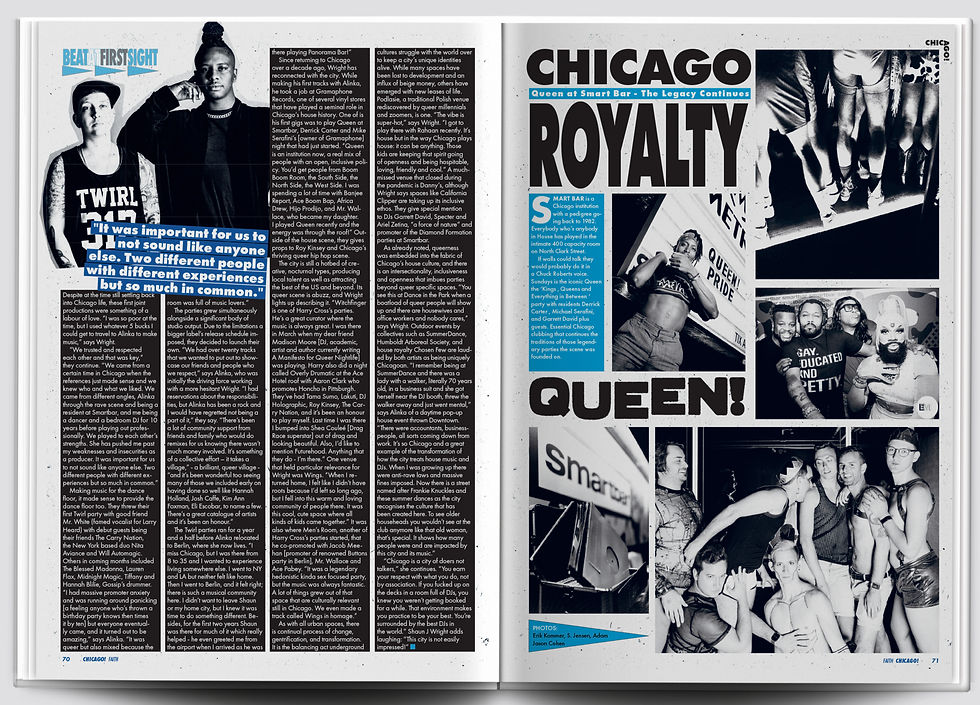
“We trusted and respected each other and that was key,” they continue. “We came from a certain time in Chicago when the references just made sense and we knew who and what we liked. We came from different angles, Alena through the rave scene and being a resident at Smartbar, and me being a dancer and a bedroom DJ for 10 years before playing out professionally. We played to each other’s strengths. She has pushed me past my weaknesses and insecurities as a producer. It was important for us to not sound like anyone else. Two different people with different experiences but so much in common.”
Making music for the dance floor, it made sense to provide the dance floor too. They threw their first Twirl party with good friend Mr. White (famed vocalist for Larry Heard) with debut guests being their friends The Carry Nation, the New York based duo Nita Aviance and Will Automagic. Others in coming months included The Blessed Madonna, Lauren Flax, Midnight Magic, Tiffany and Hannah Blilie, Gossip’s drummer. “I had massive promoter anxiety and was running around panicking [a feeling anyone who’s thrown a birthday party knows then times it by ten] but everyone eventually came and it turned out to be amazing,” says Alinka. “It was queer but also mixed because the room was full of music lovers.”
The parties grew simultaneously alongside a significant body of studio output. Due to the limitations a bigger label’s release schedule imposed, they decided to launch their own. “We had over twenty tracks that we wanted to put out to showcase our friends and people who we respect,” says Alinka, who was initially the driving force working with a more hesitant Wright. “I had reservations about the responsibilities but Alinka has been a rock and I would have regretted not being a part of it,” they say. “There’s been a lot of community support from friends and family who would do remixes for us knowing there wasn’t much money involved. It’s something of a collective effort – it takes a village,” - a brilliant, queer village - “and it’s been wonderful too seeing many of those we included early on having done so well like Hannah Holland, Josh Caffe, Kim Ann Foxman, Eli Escobar, to name a few. There’s a great catalogue of artists and it’s been an honour.”
The Twirl parties ran for a year and a half before Alinka relocated to Berlin, where she now lives. “I miss Chicago but I was there from 8 to 35 and I wanted to experience living somewhere else. I went to NY and LA but neither felt like home. Then I went to Berlin, and it felt right; there is such a musical community here. I didn’t want to leave Shaun or my home city, but I knew it was time to do something different. Besides, for the first two years Shaun was there for much of it which really helped - he even greeted me from the airport when I arrived as he was there playing Panorama Bar!”
Since returning to Chicago over a decade ago, Wright has reconnected with the city. While making his first tracks with Alinka, he took a job at Gramaphone Records, one of several vinyl stores that have played a seminal role in Chicago’s house history. One of is his first gigs was to play Queen at Smartbar, Derrick Carter and Mike Serafini’s [owner of Gramaphone] night that had just started. “Queen is an institution now, a real mix of people with an open, inclusive policy. You’d get people from Boom Boom Room, the South Side, the North Side, the West Side. I was spending a lot of time with Banjee Report, Ace Boom Bap, Africa Drew, Hijo Prodijo, and Mr. Wallace, who became my daughter. I played Queen recently and the energy was through the roof!” Outside of the house scene, they gives props to Roy Kinsey and Chicago’s thriving queer hip hop scene.
The city is still a hotbed of creative, nocturnal types, producing local talent as well as attracting the best of the US and beyond. Its queer scene is abuzz, and Wright lights up describing it. “Witchfinger is one of Harry Cross’s parties. He’s a great curator where the music is always great. I was there in March when my dear friend Madison Moore [DJ, academic, artist and author currently writing A Manifesto for Queer Nightlife] was playing. Harry also did a night called Overly Drumatic at the Ace Hotel roof with Aaron Clark who promotes Honcho in Pittsburgh. They’ve had Tama Sumo, Lakuti, DJ Holographic, Roy Kinsey, The Carry Nation, and it’s been an hour to play myself. Last time I was there I bumped into Shea Couleé [Drag Race superstar] out of drag and looking beautiful. Also, I’d like to mention Futurehood. Anything that they do - I’m there.” One venue that held particular relevance for Wright was Wings. “When I returned home, I felt like I didn’t have roots because I’d left so long ago, but I fell into this warm and loving community of people there. It was this cool, cute space where all kinds of kids came together.” It was also where Men’s Room another of Harry Cross parties started, that he co-promoted with Jacob Meehan [promoter of renowned Buttons party in Berlin], Mr. Wallace and Ace Pabey. “It was a legendary hedonistic kinda sex focused party, but the music was always fantastic. A lot of things grew out of that space that are culturally relevant still in Chicago. We even made a track called Wings in homage.”
As with all urban spaces, there is continual process of change, gentrification, and transformation. It is the balancing act underground cultures struggle with the world over to keep a city’s unique identities alive. While many spaces have been lost to development and an influx of beige money, others have emerged with new leases of life. Podlasie, a traditional Polish venue rediscovered by queer millennials and zoomers, is one. “The vibe is super-hot,” says Wright. “I got to play there with Rahaan recently. It’s house but in the way Chicago plays house: it can be anything. Those kids are keeping that spirit going of openness and being hospitable, loving, friendly and cool.” A much-missed venue that closed during the pandemic is Danny’s, although Wright says spaces like California Clipper is taking up its inclusive ethos. They give special mention to DJs Garrett David, Specter and Ariel Zetina, “a force of nature” and promoter of the Diamond Formation parties at Smartbar.
As already noted, queerness was embedded into the fabric of Chicago’s house culture, and there is an intersectionality, inclusiveness and openness that imbues parties beyond queer specific spaces. “You see this at Dance in the Park when a boatload of queer people will show up and there are housewives and office workers and nobody cares,” says Wright. Outdoor events by collectives such as SummerDance, Humboldt Arboreal Society, and house royalty Chosen Few are lauded by both artists as being uniquely Chicagoan. “I remember being at SummerDance and there was a lady with a walker, literally 70 years old, in a business suit and she got herself near the DJ booth, threw the walker away and just went mental,” says Alinka of a daytime pop-up house event thrown Downtown.
“There were accountants, businesspeople, all sorts coming down from work. It’s so Chicago and a great example of the transformation of how the city treats house music and DJs. When I was growing up there were anti-rave laws and massive fines imposed. Now there is a street named after Frankie Knuckles and these summer dances as the city recognises the culture that has been created here. To see older househeads you wouldn’t see at the club anymore like that old woman, that’s special. It shows how many people were and are impacted by this city and its music.”
“Chicago is a city of doers not talkers,” she continues. “You earn your respect with what you do, not by association. If you fucked up on the decks in a room full of DJs, you knew you weren’t getting booked for a while. That environment makes you practice to be your best. You’re surrounded by the best DJs in the world.” Shaun J Wright adds laughing: “This city is not easily impressed!”
First published in Faith zine 2023.


Comments