The Police Christened him Queer
Updated: Jul 23
Why is the story of Rev. Robert Spike's life and death important today? Why do I - his son - want to bring it to the screen now, sixty years after his murder?
That crime has never been solved. And his life story has never been told to the millions of people around the world who might take some hope from it at a time when the lessons of history - vital lessons of freedom, justice, equality - too often seem to be lost causes.
Robert Spike was a Baptist farmboy from upstate New York who grew up to become the most important white man in the American black civil rights movement of the 1960s. He was also a closeted homosexual, and as one Washington official threatened him “the FBI knows about you”.

At that moment, Spike was leading a campaign to save a group of brave volunteers who, with federal funding, were registering thousands of poor Mississippi blacks to vote. But LBJ needed the support of the two racist Mississippi senators who would block millions of dollars in Vietnam War funding until LBJ stopped funding black voter registration programs in their state. It was a secret deal between the Texas President and the two segregationist Mississippi politicians and Spike knew about it. As he had one of the most influential liberal Christian voices in the country, when he refused to abandon his campaign to save the black voters of Mississippi because of what the “FBI knows” - because of what would happen to anyone publicly exposed as a homosexual in America in 1966 (being queer in America did not become legal until 2003) - he was murdered and his death immediately depicted in the national press as a “perverted” sex crime.
There was absolutely no evidence at the crime scene to connect his death to his sexuality nor to any sex act. Yet the lying smears were rapidly spread through America and the National Council of Churches even cancelled its reward for information and an independent murder investigation. Within weeks, Spike's reputation as a leading social activist and revolutionary theologian was almost completely erased from history. A biography of him was cancelled. His own books went out of print.
So it was that three years after his death I sat down, aged 22 and wrote a book called Photographs of My Father. It was my attempt to tell the truth about his life and death in so far as I could, without being either a detective or a historian. It was chosen as one of the best books of the year by the New York Times, but my main goal in writing it was not achieved. No new investigation was launched. No historian picked up the story - not until decades later when Pulitzer Prize winning historian Taylor Branch published his three volumes on the civil rights movement.
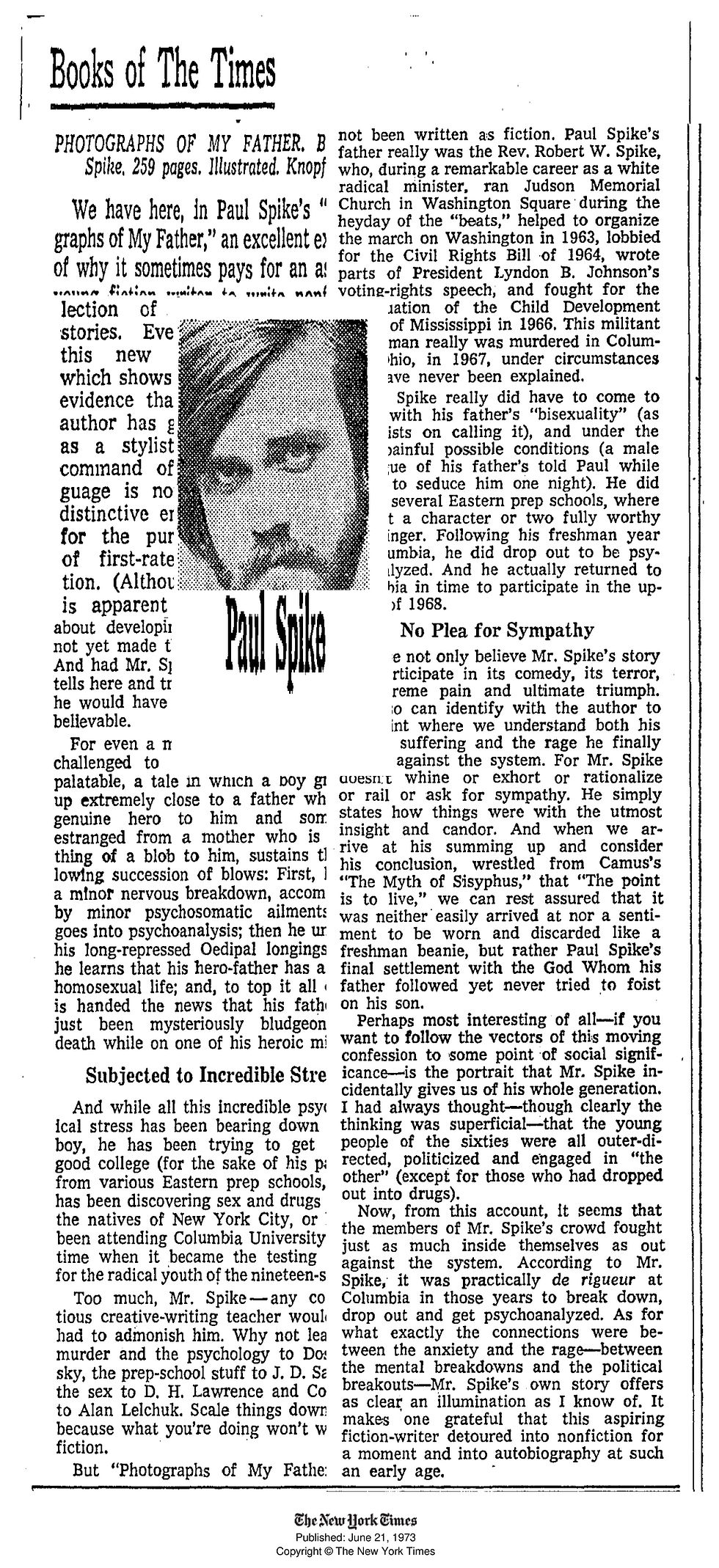
After my book was published, I left America as a political expatriate and settled in London. I've lived here for 50 years now, writing and editing, but not returning to my father's story until two years ago when I realised that, at the age of 76, this was one story I needed to finish, to reopen an investigation and to bring his life to the screen.
In today's world under a darkening storm canopy of authoritarianism, digital misinformation, poisonous racism and homophobic violence, where were the heroic leaders to light our way forwards to a new horizon? Some of these heroes are yet to emerge - and some were disappeared because of their sexuality. Robert Spike's story, I believe, has much to tell us about a historic struggle for human rights, and about courage, sacrifice and justice. But, most importantly, about how to secure our own future.
Words by Paul Spike
Discover more about the extraordinary life and death of Robert Spike here.
We'll be speaking with Paul on July 24th at Eagle London followed by a fundraising party with special guest and house legend Terry Farley. All profits will go towards the documentary to tell Robert Spike's story. Tickets here.


Comments