Hercules and Love Affair's Andy Butler on Music as Redemption.
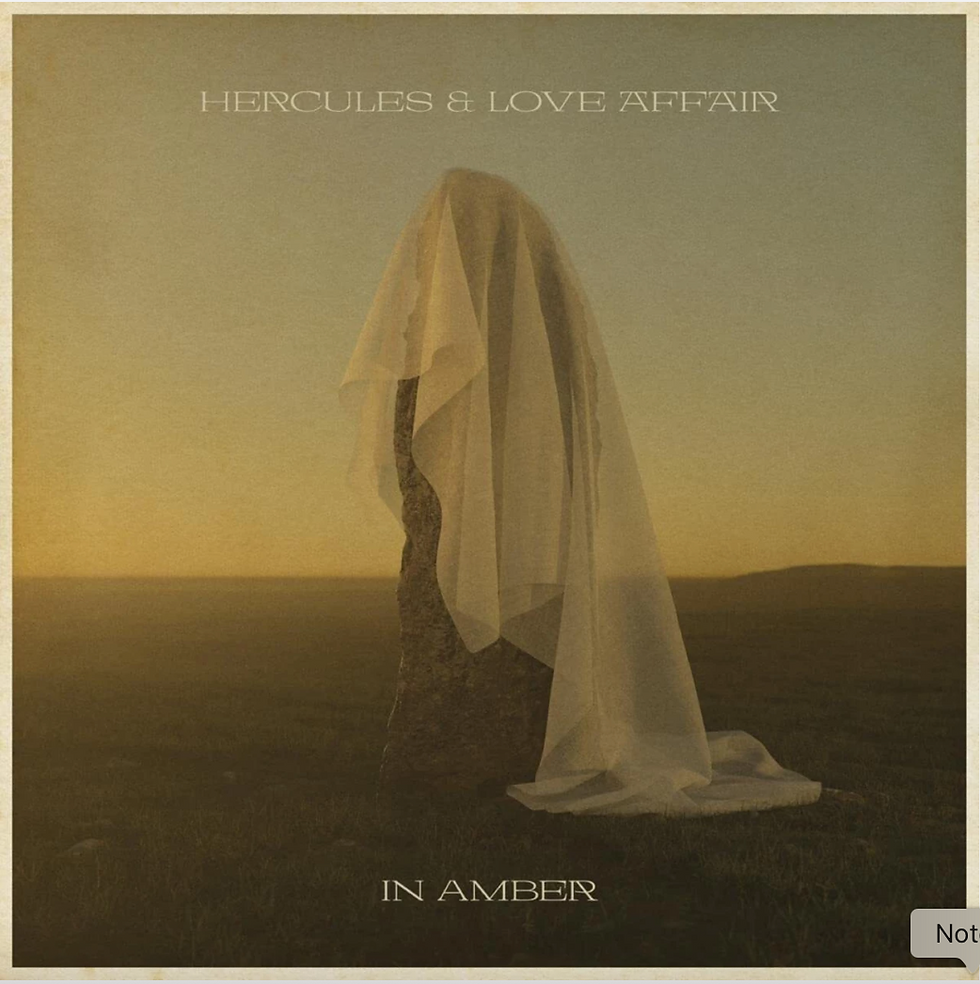
I'm republishing here a series of articles and interviews originally written for Faith zine. This is an interview I did with Hercules and Love Affair's Andy Butler for his album In Amber.
There is a disarming ingenuousness to Andy Butler that sits incongruently with the queer underground he both grew out of and came to be recognised by. Having put out consistently well-received records steeped in the history and culture of house and disco for nearly a decade and a half, his enthusiasm and sincerity talking about his music and creative partners is unaffectedly charming. His ever-evolving project, Hercules and Love Affair, puts out its fifth album In Amber this summer and, for the first time since their 2008 seminal house-hymn ‘Blind’ had dance floors writhing in communal ecstasy around the globe, he has once again collaborated with his long-time friend, ANONHI. While years have passed since they appeared on Hercules’ debut eponymous album, the creative connection that birthed brilliant music, remains.
“She’s always had this way of combining abstraction and directness to create lyrics that cut to the chase but that are also quite stream-of-consciousness,” he says from his mother’s home in Denver where has been visiting between a mini-US DJ tour. “She can conjure up in three or four words these very evocative and poignant images. They are quite magical.” That magic is showcased on the second single, ‘Poisonous Storytelling’, sonically a sharp departure from the four-to-the-floor redemptive anthems Butler is associated with. The track, like much of the album, is ambitious, unexpected, and hauntingly solemn, with ANONHI’s choral chant pouring over scattergun drums, delivering prophetic words of social degradation. (“Human female husbandry” speaks of so many bad things so well in three short words.)
“I had reservations about it even being a Hercules record,” Butler says. “Having worked within the genres of house, disco, techno, these established sounds that have been there for almost 50 years, it became clear to me that I wanted to step outside of this artistically and that I needed to push myself. On some songs I’m working in metres of five, or nine, that have very stark moods, with this intense emotional vocal presence almost akin to This Mortal Coil or Dead Can Dance.”
When listening to In Amber for the first time, this departure from what came before is dramatic, but less so when placed in the context of the singer-songwriter’s story.
“I grew up in a military household where there was quite a high level of expectation put upon the children,” he says. “It was a competitive approach - and it was clear from a young age that there were certain expectations that I was not going to meet: I wasn’t going to fit certain moulds.”

Before going further, he stresses that despite tensions at home, his parents supported him in many ways that he came to appreciate later in life. “There were hard trials growing up,” he acknowledges, “but gifts were borne out of those trials. I have a great, loving relationship with them now.” Indeed, the genesis of Hercules and Love Affair came from this early recognition of their son’s sensitivity and difference. “There was an unused piano that sat in the house and amidst what was sometimes chaotic and scary stuff, I found my safe space,” Butler recalls. “I would sit at it for hours trying to make beautiful sounds.” Recognising there was an innate talent, his parents got him lessons and by 12 he was writing music.
While speaking of his sensitivity, what also emerges is a fearlessness and curiosity in seeking what he needed. He came out at 15 to his family in 1992. This was the year before Clinton’s Don’t Ask, Don’t Tell policy, not insignificant given the family’s military setting, and the gay rights movement still reeling from and fire-fighting HIV, that was at the time an untreatable disease. “It caused a lot of stress announcing that to my family, particularly because a relative had died of AIDS. There was a lot of fear. I know now they did their best, but they didn’t know how to deal with it. I knew I had to find my people.”
He started by attending a local gay and lesbian youth support group where he met other queer kids, some who had been kicked out of home because of their sexuality, some who were HIV positive. By 1995 his inquisitiveness resulted in underage raving at Denver’s thriving underground scene, a volcanic eruption of sound, community and substances. “I had some incredible nights. A lot of those parties were informed by the West Coast sound of house music that was taking place in San Francisco, with a lot of British expats, notably members of the Tonka Soundsystem - people related to Harvey, DJ Garth, Dubtribe plus Chicago transplants like Mark Farina. Major DJs presenting the roots. I would go to after-hours at 17 years old listening to some of these DJs play 8-hour sets,” he says, becoming visibly energised at the memory of these formative events. “You can’t underestimate the impact house music had on my life. In many ways it saved me.” On a visit with his parents to New York, he snuck out to hear Louie Vega, Armand van Helden and Junior Sanchez at the Roxy. “I was already sniffing it out,” he says laughing.
“I moved to New York at 18 and things were already full on. I soon found myself in trouble,” he says. “I’ve been open about my addiction and recovery journey, and I was struggling in the grips of serious abuse of drugs and alcohol at a very early age. The best thing that could have happened to me was getting into too much trouble and being forced to check out some recovery meetings. It was in those spaces that I started to meet these incredibly vibrant, creative, amazing queer people who were living their lives drug-free, alcohol-free, and were having tons of fun and expressing themselves to the max.”
They advised him to take his time, to not dive back into nightlife before he was ready and encouraged him to explore his music. “I had a few years like that knowing I could pick the DJing up later, which I eventually did. All the while because the piano was my creative outlet, I was writing music – very rudimentary music!” he adds. “It was the moment that electroclash was taking off in the early 2000s and I started to put together a little collection of people around me to just record vocals on songs I was making – this was seven years before Hercules – and I was recording these post-punky, electronic tracks. I was listening to a lot of Cabaret Voltaire, although the result was no so much like them…”
A trademark of Hercules and Love Affair is its amorphous nature, an ever-changing roster of musicians and vocalists who orbit around Butler for a particular project. An eclectic festival programmer’s wet dream of a cast has contributed: ANOHNI, Shaun J. Wright, Kim Ann Foxman, Kele Okereke, John Grant, Aérea Negrot, Krystle Warren not to mention on In Amber, Icelandic singer Elin Ey and Butler himself who sings on several tracks, a breakthrough he credits to ANONHI. “On our first day she handed me the mic and told me she’d be back in a few hours – that’s not what I had planned! In some ways the seeds for Hercules were really planted back then in New York. I’d invite friends, not necessarily music people, and get them to sing on a track and then I’d slip DJs CDs at parties. I remember the first time hearing one of my tracks played out at a party for Repellent, a music zine that took the music seriously, and it being a huge moment for me.”
This early circle of contributors included one who was musical - to the bone. “I’d heard ANOHNI’s music but I had this desire to hear her voice over an electronic beat. We ended up writing and recording together and came up with ‘Blind’. And then for five years nothing happened with it beyond me doing remixes in various genres,” he laughs. Then in 2005 ANONHI’s band Antony and the Johnsons scooped the Mercury Prize for I Am a Bird Now. “After that she asked what I was doing with the song and suggested I put it out.” One of the DJs who had received an early CD was Daniel Wang, who had become a friend, and who in turn introduced him to James Murphy at DFA who released his debut album. The record received universal acclaim with Pitchfork naming ‘Blind’ the best song of 2008. Butler’s days of sending off CDs to DJs were over.
Fourteen years on and the track can be safely included in the canon of great house tracks, and it got some help getting there from a man who helped define the genre. “My agent at the time, Maria May, had a history with Red Zone Productions, and when ‘Blind’ was finished, she asked if I would like her to ask Frankie Knuckles to do a remix. I was like - WTF! YES - but I just didn’t think it would happen. There was a delay because he had some health issues, but he resurfaced and said he really wanted to do the song.”
Butler admits he had some nervousness about the result. “People who have had such a long and sustained career understandably have the need to update and change. This was Frankie in 2007/8, not 1992, but within the first minute I heard a piano riff come in that directly referenced the melody to the song and immediately I thought, ‘This is magic – they got it’. I was brought to tears.”
“Listening to ‘The Whistle Song’ literally helped me survive as a queer 16-year-old. As a young artist with a debut album, my first single was being remixed by someone who as a teenager had helped me find purpose in my life through his music. The weird thing is,” he adds with a smile. “I had actually taken the bassline from ‘Your Love’ and incorporated it into ‘Blind’.”
Did Frankie know?
“He did. I got to meet him in Spain at the first international performance Hercules did and he invited me to dinner. I was nervous. We sat down and the first thing he said to me was: ‘So, I heard you took a few notes from one of my songs and incorporated it into one of your songs…?’ I didn’t know what to say. I just mumbled something along the lines of, ‘I really hope you don’t feel offended…’ and he stopped me and said: ‘Girl, it’s fine, calm down - that was true homage.’”
Still visibly moved by the memory Butler says, “I played with him a few times, I actually got to back-to-back with Frankie Knuckles, which was crazy – he was superb and I played horribly. At that age it was an intimidating experience. He was an incredibly gracious and beautiful spirit. It was wonderful.” His eyes light up when remembers these times. “You can’t underestimate the impact that remix had. It was huge and it went everywhere. I was super fortunate to have had that happen and to have gotten to know him and received his blessing around my cheeky attempt at sneaking a bit of his magic. I don’t know if I’ll ever get a remix that will trump that one.”
What is evident after over an hour talking is a sincere sense of gratitude Andy Butler has for his life. He has been candid about his past struggles with drugs and alcohol, but the spiritual, psychological, and emotional work he has done to meet those challenges has resulted in a more contemplative and complex artist, who is showing a yet unrevealed dimension of their creativity on this forthcoming record. The themes, track titles (‘Grace’, ‘Who Will Save Us Now?’, ‘Repent’…) and tones allude to big life questions usually left to philosophy and religion. “There was a need to excite myself and to reflect what was going on in my life. A lot of the sounds, mood and lyrics are much more reflective of my internal process and experience of the past five years, which have not been easy years,” he says. “If I’m putting forward my experience as an artist then it’s been fraught with disappointment and disillusionment, and I started to think about what really matters in this life. You hear the frustration, the angst, but I have taken a lot of satisfaction in making it and I don’t think I can ask for more. It’s the record I needed to make and I’m really proud of it.”


Comments